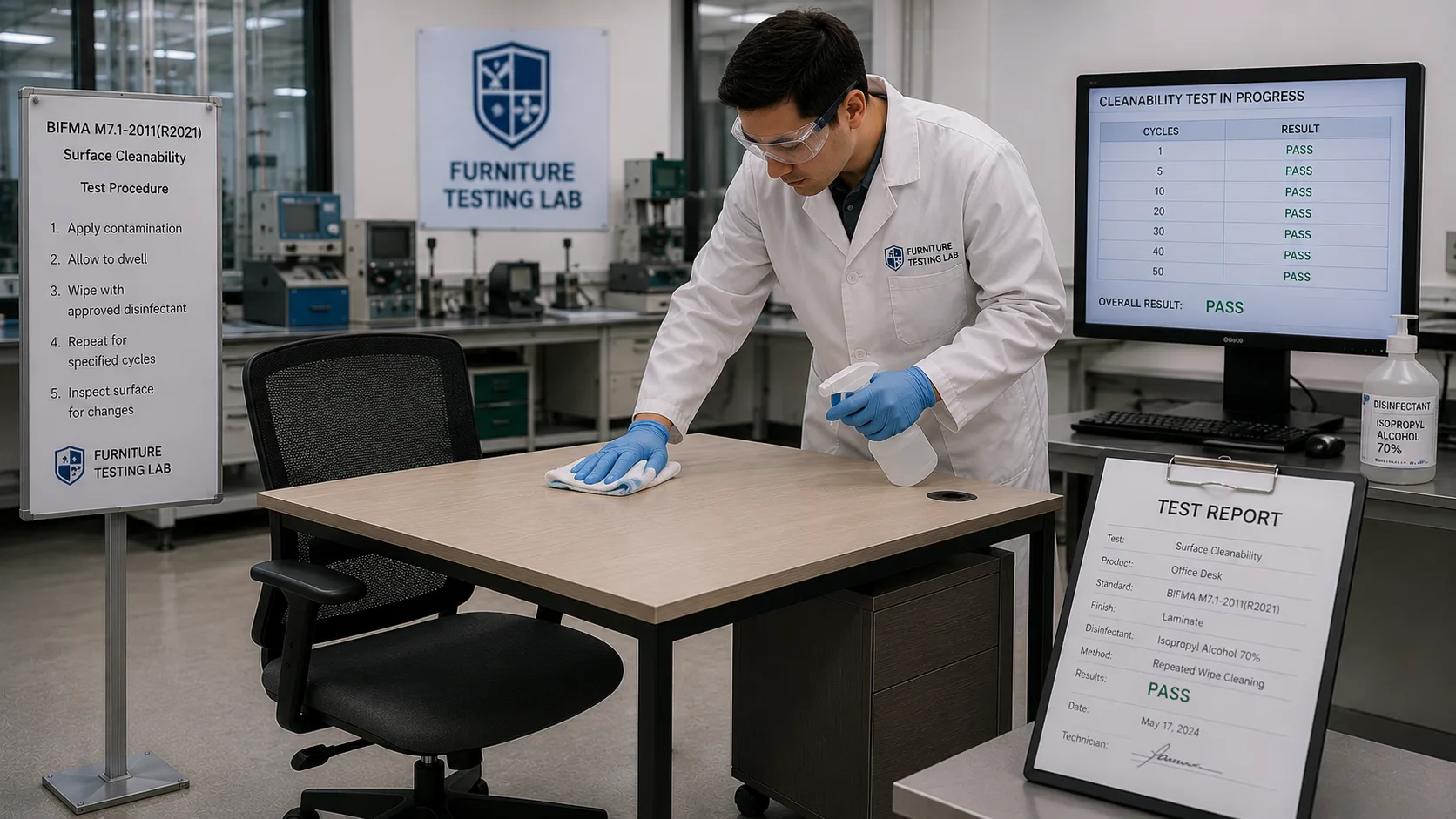
Cleanability has become a qualification criterion for commercial furniture, not just a marketing claim. As contract buyers increasingly source from Southeast Asian factories, the question of whether a product can survive routine chemical cleaning — and prove it — has moved from an afterthought to a requirement.
The BIFMA Clean Guide is a practical framework that addresses how commercial furniture products should be evaluated and documented for cleanability. Understanding what the guide covers, what it does not cover, and how to apply it during supplier qualification prevents downstream problems.
What the BIFMA Clean Guide is
The BIFMA Clean Guide is a guidance document published by the Business and Institutional Furniture Manufacturers Association. It is not a performance test standard in the same way BIFMA X5.1 or BIFMA X5.5 are. It is a reference framework that defines how cleanability claims for commercial furniture products should be structured, evaluated, and communicated to buyers and specifiers.
The guide addresses the cleaning agents, protocols, and procedures relevant to commercial environments — including office, healthcare, and education settings. It is particularly relevant for products where surface finish durability under repeated disinfection is a legitimate buyer concern, not just a cosmetic one.
Why cleanability matters in commercial sourcing
Commercial buyers sourcing furniture for institutional or contract use increasingly encounter cleanability as a specification requirement. Healthcare environments require surfaces that withstand repeated disinfection with hospital-grade agents. Education and hospitality environments have similar requirements, though often with different chemical tolerances and cleaning protocols.
A surface finish that passes standard scratch and wear tests may still fail under repeated exposure to common cleaning agents — bleach-based disinfectants, quaternary ammonium compounds, and alcohol-based wipes being the most common. A supplier who can demonstrate cleanability to a defined protocol is in a materially stronger position than one who cannot. Surface finish failures discovered after delivery create costly claim exposure.
What the guide actually covers
The BIFMA Clean Guide covers:
- definitions of cleanability and the cleaning environments the guide addresses
- a framework for documenting cleaning agent compatibility with surface finishes
- guidance on how cleanability test results should be reported
- protocols for evaluating surface finishes under representative cleaning conditions
- terminology alignment for use in specifications and procurement documents
The guide is designed to help buyers, specifiers, and manufacturers speak a common language when cleanability is a formal qualification requirement.
What the guide does not cover
The BIFMA Clean Guide does not replace product performance standards. It does not address structural integrity, load capacity, or ergonomic suitability. A product that aligns with the Clean Guide framework can still fail BIFMA X5.1 load tests or fail CARB formaldehyde emission requirements. These are separate evaluation tracks that must be managed independently.
The guide also does not certify antimicrobial performance. US retailers and institutional buyers who require antimicrobial claims will need additional documentation beyond cleanability framework alignment. Cleanability and antimicrobial performance are distinct product attributes.
How to apply it during supplier qualification
When cleanability is a specification requirement for your product category, the BIFMA Clean Guide gives you a structured basis for evaluating supplier claims. The useful questions are: What cleaning agents has the finish been evaluated against? What protocol was used? What was the test duration and concentration? What is the current test documentation, and has the finish formulation changed since evaluation?
Vague cleanability claims — "easy to clean," "wipe clean," "chemical resistant" — without protocol documentation are not adequate in commercial procurement. The BIFMA Clean Guide gives buyers the technical language to demand better documentation from suppliers. Applying this rigor during factory qualification in Southeast Asia prevents finish failures from becoming shipment claims.
If cleanability documentation is a requirement in your supplier qualification process, Top Systems Group can help define the right evaluation criteria and verify supplier compliance before production begins.
Talk to our team →Treat cleanability as a specification, not an assumption
The BIFMA Clean Guide is most useful when cleanability is treated as a defined specification requirement, not an assumed product attribute. Buyers who include cleanability protocols in their factory qualification documents, test plan requirements, and product specifications are in a much stronger position than those who rely on unverified supplier claims.
Used correctly, the guide helps close the gap between what a supplier claims about a product's surface durability and what the product actually delivers under commercial cleaning conditions. That gap is where claim exposure lives.
Key Takeaways
- The BIFMA Clean Guide is a guidance framework, not a product performance test standard
- It defines how cleanability claims should be structured, evaluated, and documented
- It is relevant for contract buyers sourcing for healthcare, education, and hospitality environments
- Cleanability claims without protocol documentation are not adequate for commercial procurement
- The guide should be used alongside — not instead of — structural performance standards
- Cleanability and antimicrobial performance are separate product attributes requiring separate documentation