BIFMA X5.1 is the most widely referenced standard in commercial seating procurement. It appears in retailer compliance requirements, institutional procurement specifications, and supplier qualification documents across virtually every US commercial furniture buying context. Yet most buyers who rely on it have never actually read it — and the gap between what they assume it covers and what it actually tests is where qualification errors happen.
This is a plain-language explanation of what BIFMA X5.1 actually tests, what the test results mean, and what the standard does not tell you about a chair's suitability for your specific use case.
What BIFMA X5.1 is
BIFMA X5.1 is the ANSI/BIFMA standard for general-purpose office seating. It was developed by the Business and Institutional Furniture Manufacturers Association to establish minimum performance requirements for chairs used in commercial office environments under typical duty conditions. It is the most commonly referenced seating standard in US commercial procurement — not because it is the only standard, but because general-purpose office seating is the largest single seating category in commercial environments.
It is important to note what "general purpose" means in this context. X5.1 is calibrated for conventional office task seating used during normal working hours. It is not designed for 24-hour or shift-work environments, for high-use institutional applications, or for specialized ergonomic products that require additional testing. Those categories have their own relevant standards and test requirements.
The key tests in X5.1
X5.1 covers a comprehensive range of structural and functional tests. The most important ones for buyers to understand are:
- Seat drop test — a weighted drop onto the seat, repeated thousands of times, simulating the impact of sitting down across the product's service life
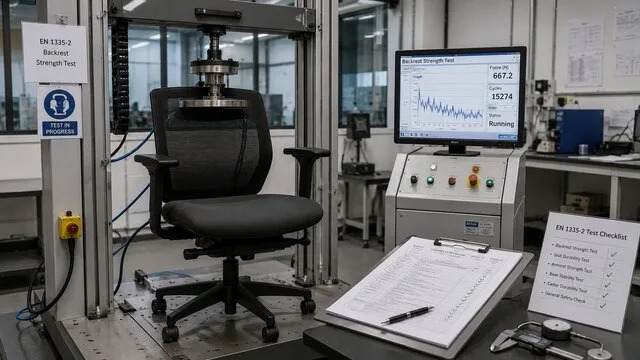
- Back pull test — applying force to the chair back to evaluate structural integrity under loading
- Arm strength tests — downward and lateral loads on armrests to evaluate arm attachment integrity
- Leg and base tests — forward and rearward loading of the leg/base assembly to evaluate structural integrity
- Stability tests — evaluating tip resistance under representative loading scenarios
- Seat and back fatigue cycling — high-cycle tests simulating extended use across the product's intended service life
- Caster and glide tests — evaluating floor interface components under load and movement
Each test has defined load values, cycle counts, and pass criteria. The cycle counts in particular are calibrated to represent years of normal commercial use. A chair that passes all X5.1 tests has been evaluated against a validated model of what normal commercial seating use actually does to a product over time.
What a test report looks like
A valid BIFMA X5.1 test report should specify the product configuration tested (model, materials, components), the test laboratory and its accreditation, the standard version and date, and pass/fail results for each individual test in the standard. A report that says only "BIFMA X5.1 compliant" without individual test results is not useful for procurement verification.
Buyers should also verify that the tested configuration matches what they are actually sourcing. A test report for a chair in one fabric, gas cylinder rating, or base configuration does not automatically cover a different variant. Material and component changes between prototype and production can affect test relevance.
What X5.1 does not tell you
Passing BIFMA X5.1 does not confirm ergonomic suitability. It does not validate lumbar support effectiveness, adjustability range adequacy, or comfort for extended sitting. These are separate evaluation dimensions that X5.1 was not designed to address.
X5.1 also does not confirm fabric durability, cleanability, formaldehyde emission compliance for any foam or composite components, or packaging performance. It does not validate that the product meets retailer-specific requirements beyond the structural tests in the standard. These must be documented independently.
X5.1 versus occasional-use standards
X5.1 is calibrated for commercial-duty use. BIFMA X6.4 covers occasional-use seating at a lower duty cycle, and BIFMA X6.5 covers home office seating at residential-grade parameters. These are not substitutes for X5.1 in commercial procurement. Buyers who accept an X6.4 certification for a product intended for commercial task use are validating the wrong use condition.
If BIFMA X5.1 compliance is a requirement for your seating category and you need to verify supplier documentation, Top Systems Group can review test reports and assess configuration alignment before production is committed.
Talk to our team →Using X5.1 as a procurement tool
BIFMA X5.1 is most useful when buyers specify their requirements clearly: which standard, which version, which configuration, from which accredited laboratory. A supplier who has a valid X5.1 test report that matches your product configuration has demonstrated a meaningful level of structural qualification. A supplier who has a vague "BIFMA certified" claim has demonstrated nothing verifiable.
Include X5.1 test report requirements — with specific documentation requirements — in your factory qualification process. The time to discover compliance gaps is before production, not after delivery.
Key Takeaways
- BIFMA X5.1 is the standard for general-purpose commercial office seating under normal duty conditions
- Key tests include seat drop, back pull, arm strength, leg and base integrity, and fatigue cycling
- Test reports must specify the configuration, lab, standard version, and individual test pass/fail results
- X5.1 does not validate ergonomics, cleanability, emission compliance, or packaging performance
- X6.4 (occasional use) and X6.5 (home office) are not substitutes for X5.1 in commercial procurement
- Configuration changes between the tested sample and production require re-evaluation of test relevance