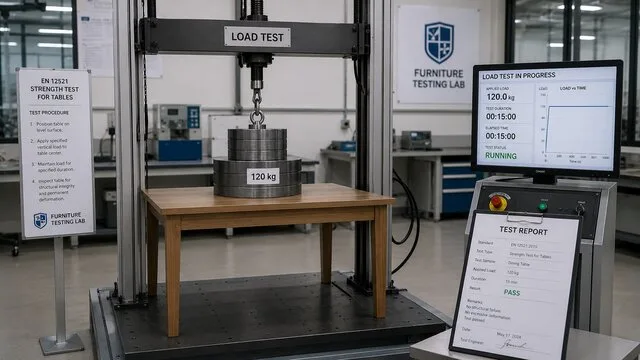
Furniture load testing is one of the least understood parts of commercial furniture procurement, and one of the most consequential. Buyers who know how to read a test report can identify products that are genuinely qualified for their intended use. Buyers who cannot distinguish between a rigorous test protocol and a minimum-pass result are flying blind when approving product for retail or institutional deployment.
This is a practical guide to what furniture load testing actually involves — what it tests, what the numbers mean, and how retailers use test documentation in their approval process.
What load testing is actually measuring
Load testing applies controlled forces to furniture components to evaluate structural integrity and predict performance over the product's expected service life. Tests simulate the loads a product will experience in normal use — people sitting, leaning, pushing, pulling, cycling drawers — and apply those forces in a controlled laboratory environment to determine whether the product can withstand them without failure.
The key output of a load test is not just pass or fail. It is a documented record of the forces applied, the test methodology used, the failure modes observed (if any), and the performance relative to the defined pass criteria. That documentation is what retailers evaluate during product approval.
Static versus dynamic load tests
Furniture load testing includes both static and dynamic tests. Static load tests apply a fixed load for a defined duration and measure deflection, deformation, or failure. A shelf load test, for example, typically involves applying a defined weight to a shelf for a set period and measuring the resulting sag.
Dynamic load tests — often called fatigue or cycle tests — simulate repeated use over time. A seat drop test cycles a defined load onto a chair seat thousands of times to simulate years of daily use. These tests are designed to identify fatigue failures that would not appear in a single static load application but that emerge after extended use.
Both test types matter. Static tests catch immediate structural inadequacy. Dynamic tests catch products that will fail after some period of normal use — often the ones that cause the most expensive field claims.
How retailers use test documentation
Major US retailers including large-format home improvement stores, online furniture retailers, and institutional contract buyers require test reports as part of their product approval process. The requirements vary by retailer, but common elements include:
- the specific standard used (BIFMA X5.1, X5.5, X5.9, or similar)
- the name and accreditation of the test laboratory
- the exact product configuration tested (dimensions, materials, component specifications)
- the test date and report reference number
- pass/fail results for each test in the standard
A vague statement that a product "meets BIFMA standards" without a supporting test report is not adequate for retail approval processes. Retailers add their own requirements on top of published standards and verify compliance through test report review, not supplier declarations.
What test reports do not tell you
A test report tells you what the tested product configuration was capable of on the day it was tested at the test laboratory. It does not tell you whether current production matches that configuration, whether the supplier has changed materials since the test, or whether production-line quality control ensures consistency between the tested sample and every unit shipped.
This is why pre-shipment inspection and production oversight matter alongside test documentation. A valid test report on an inconsistently manufactured product does not protect a buyer from field claims.
Packaging load tests
Load testing furniture is not only about the product itself. Packaging drop tests evaluate whether the product survives transportation from factory to warehouse to customer. Retailers require packaging drop test documentation for the same reason they require structural test reports — because products that arrive damaged create return costs, replace requests, and claim exposure that affect the entire supply chain relationship.
If load testing documentation is a requirement for your retail approval process, Top Systems Group can help coordinate test plans, verify lab accreditation, and ensure test configurations match your production specification.
Talk to our team →Building test requirements into sourcing from the start
The most effective approach to furniture load testing is to specify test requirements before production begins — not after samples are approved and production is running. Buyers who include specific test standards, laboratory requirements, and configuration documentation in their factory qualification process avoid discovering compliance gaps after production is complete and goods are ready to ship.
Load testing is not an administrative step at the end of the procurement process. It is a qualification tool that should inform product development, sample approval, and production sign-off.
Key Takeaways
- Load testing applies controlled forces to simulate normal use and evaluate structural integrity
- Static tests measure immediate structural performance; dynamic cycle tests predict long-term fatigue behavior
- Retailers require test reports specifying the standard, lab, configuration, test date, and pass/fail results
- A "meets BIFMA" declaration without a test report is not adequate for retail product approval
- Test reports document the tested sample — they do not guarantee production-line consistency
- Packaging drop tests are a separate but equally important part of the retail approval documentation package