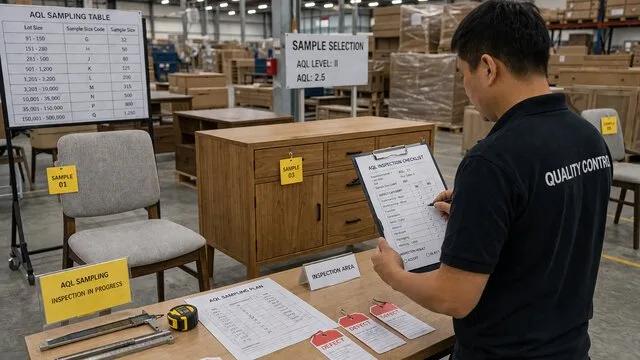
Furniture shipment claims are expensive, slow to resolve, and frequently avoidable. Most of the root causes are known in advance — they follow predictable patterns that experienced buyers and sourcing partners have seen enough times to anticipate. The problem is not a lack of awareness. It is a failure to build the prevention steps into the sourcing process systematically rather than reacting to claims after they happen.
This is a practical breakdown of where claim exposure is highest, what creates it, and what documentation and process changes reduce it before a container is loaded.
Packaging failure is the most common claim driver
The majority of furniture shipment claims originate in inadequate packaging. A chair or case good that performs perfectly at the factory can arrive at a US warehouse with corner damage, transit scratches, broken legs, or crushed panels — not because the factory made a defective product, but because the packaging was not engineered for the actual transit conditions the product would experience.
Trans-Pacific shipping involves loading, unloading, container stacking, vessel movement, and last-mile delivery handling. Each of these events applies forces to packaged goods that the packaging must absorb. Packaging that works for local truck delivery in Malaysia does not necessarily protect against the compressive forces of an ocean container loaded for a 21-day voyage.
The solution is packaging drop testing — a defined test protocol that validates packaging performance against the forces the product will actually experience. Retailers who require packaging drop test documentation are not being bureaucratic. They are protecting against exactly this category of claim.
Surface finish damage in transit
Surface finishes are vulnerable during transit in ways that are distinct from structural damage. Abrasion from vibration, moisture ingress from condensation, UV exposure through inadequately sealed containers, and chemical off-gassing from other cargo can all affect surface quality between factory and warehouse. A finish that looks perfect at pre-shipment inspection can arrive with bloom, whitening, or micro-scratching that creates claim exposure at retail.
Protective packaging materials — interleaving papers, foam corner protection, stretch wrapping, and moisture-barrier bags — address different aspects of this risk. The appropriate combination depends on the specific surface finish, the transit route, and the time of year. A sourcing partner with experience shipping from Southeast Asia to US warehouses has already mapped these variables.
Missing or incorrect hardware
Assembly hardware claims are disproportionate in volume relative to their cost. A shipment of 500 chairs with missing cam locks or a batch of flat-pack cabinets with the wrong screw size generates customer complaints, return requests, and replacement shipments that collectively cost far more than the hardware itself. Hardware packing accuracy is a quality control discipline that requires specific attention — it is not automatically captured by general AQL inspection protocols unless hardware is explicitly included in the inspection scope.
Finish inconsistency across a production run
Color and finish variation across a production lot creates retail claim exposure, particularly for products that will be displayed in sets or sold as multi-piece collections. A dining table and four chairs that were produced at different points in the production run may show visible finish variation under retail lighting conditions — a quality issue that is invisible at the factory and highly visible at the store.
Finish consistency requires a golden sample reference that production supervisors are actively checking against throughout the run, not just at the end. It requires consistent raw material batches — stain and lacquer from the same batch applied in the same spray booth conditions. These are process disciplines, not outcomes that can be inspected in at final quality check.
Documentation gaps create claim payment delays
Even valid claims are harder to resolve when documentation is incomplete. A claim for transit damage without a pre-shipment inspection report that documents the goods' condition at loading is a dispute rather than a straightforward resolution. Bills of lading, packing lists, inspection reports, and photographic documentation at loading are the evidence chain that separates claims that resolve quickly from claims that drag for months.
Top Systems Group manages pre-shipment inspection, packaging validation, and documentation protocols across production runs in Malaysia, Vietnam, and Indonesia to reduce claim exposure before goods leave the factory.
Talk to our team →Claim prevention is a process investment, not a cost
The cost of packaging testing, pre-shipment inspection, and production quality oversight is small relative to the cost of a shipment claim — and smaller still relative to the cost of a retailer relationship damaged by recurring quality problems. Buyers who build claim prevention into their sourcing process as a standard element rather than a discretionary add-on find that the investment pays for itself.
Key Takeaways
- Packaging failure is the most common driver of furniture shipment claims — packaging drop testing addresses it systematically
- Surface finish damage in transit requires product-specific protective packaging, not just generic carton packing
- Hardware accuracy requires explicit inclusion in AQL inspection scope — it is not automatically covered
- Finish consistency across a production run requires a golden sample reference used actively throughout production
- Documentation at loading — inspection reports, packing lists, photos — is the evidence base for claim resolution
- Claim prevention investment is less expensive than claim resolution — build it into the sourcing process as standard