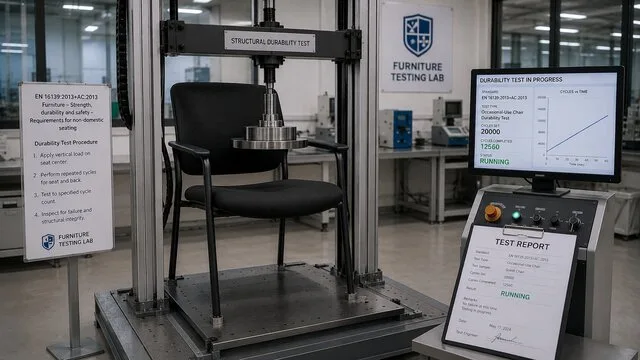
BIFMA X6.4-2018 is a standard that is easy to misread. It looks like a lighter version of BIFMA X5.1, the general-purpose commercial seating standard. In a sense, it is — but the difference in what each standard validates is significant enough that treating them as interchangeable creates real qualification problems.
X6.4 covers occasional-use seating. That is a specific product category with a specific intended use context. The standard is not trying to cut corners on commercial seating. It is trying to define appropriate performance requirements for seating products that are not used at commercial-duty frequency. Understanding that distinction is the foundation for applying X6.4 correctly.
What X6.4-2018 covers
BIFMA X6.4-2018 establishes performance requirements for occasional-use seating products. The standard applies to chairs, stools, and benches intended for light-duty or occasional-use environments — conference rooms used infrequently, waiting areas, home offices, hospitality settings, and similar contexts where seating will not be occupied at the intensity and duration typical of task seating in a commercial office.
The 2018 edition replaced the earlier iteration of the standard and updated test methodologies to reflect more current understanding of occasional-use seating loads and failure modes. It is the current reference for this product category.
How X6.4 differs from BIFMA X5.1
The most important difference is the duty cycle. BIFMA X5.1 is designed for general-purpose commercial seating — task chairs, conference chairs, and similar products expected to be in continuous use during the working day across many years of service. X5.1 uses higher cycle counts in fatigue tests and more demanding load thresholds to reflect that intensity.
X6.4 uses cycle counts and load levels appropriate for seating that sees significantly lower use frequency. This is not a deficiency — it is an accurate representation of what occasional-use seating actually experiences. A chair in a seldom-used conference room does not need to pass the same fatigue cycle count as a task chair used by someone sitting in it eight hours a day.
When X6.4 is appropriate and when it is not
X6.4 is appropriate for seating products clearly positioned in occasional-use environments: hospitality chairs, waiting room seating, infrequently-used conference chairs, residential dining chairs, and similar categories. It is not appropriate for task seating, seating in heavily-used commercial areas, or any application where the chair will be occupied at commercial-duty frequency.
A common qualification error is using X6.4 for products that will actually be deployed in commercial-duty environments. The lower cycle count in X6.4 tests means the product has only been validated at a fraction of the loading intensity it will actually experience. This is where structural failures that should have been caught in qualification appear in the field instead.
What X6.4 does not validate
X6.4 does not validate ergonomic suitability, finish durability, cleanability, or packaging performance. It does not address retailer-specific requirements beyond structural performance. A seating product can align with X6.4 and still fail CARB emission requirements if it uses composite wood components, fail packaging drop tests, or fail cosmetic quality specifications.
The standard also does not address weight capacity beyond the test parameters defined in the standard. Buyers who source seating for environments where heavy-duty weight capacity is a stated requirement should verify that X6.4 test conditions align with that requirement — they may not.
If X6.4 is being used to qualify seating that may be deployed in commercial-duty environments, Top Systems Group can assess whether the standard matches the actual use case before production is committed.
Talk to our team →Applying X6.4 correctly in procurement
The correct application of X6.4 starts with an honest assessment of how the seating will actually be used. If the answer is genuinely occasional use — infrequent occupation, light-duty environments, residential or hospitality contexts — X6.4 is an accurate and appropriate qualification reference. If the answer involves extended daily use or commercial environments, X5.1 or another higher-duty standard is needed.
Buyers who specify the correct standard in their qualification documents eliminate the ambiguity that allows suppliers to default to whichever certification they already have on file.
Key Takeaways
- BIFMA X6.4-2018 covers occasional-use seating — not commercial-duty task seating
- It uses lower cycle counts and load thresholds appropriate for infrequent use environments
- It is appropriate for hospitality, waiting areas, home offices, and similar low-frequency use contexts
- Using X6.4 for commercial-duty seating creates qualification gaps that show up as field failures
- It does not validate ergonomics, cleanability, finish durability, or packaging performance
- Buyers must specify the correct standard to prevent suppliers defaulting to their easiest existing certification