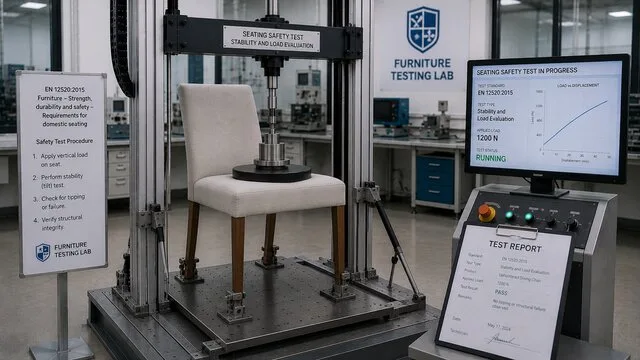
UL 1678 appears less often in commercial sourcing conversations than BIFMA. That does not make it less important. It simply serves a different purpose. That difference is where many buyers misread it.
UL 1678 is not a general furniture quality standard. It is not a broad commercial seating benchmark. It is not a substitute for BIFMA. It serves a narrower and more specific function.
UL 1678 is a safety standard associated with household-use seating. Its role is to establish a structured basis for evaluating whether in-scope seating products meet defined safety expectations under the use conditions the standard was written to govern.
It is useful when interpreted correctly. It becomes misleading when suppliers use it as shorthand for broad seating quality or commercial readiness.
UL 1678 is a safety standard, not a broad performance standard
The first distinction buyers should keep clear is structural. UL 1678 is primarily a safety standard. That is not the same thing as a broad furniture performance standard.
This matters because UL and BIFMA do not serve the same primary role. BIFMA standards are generally used to evaluate product performance under expected commercial-use conditions. UL 1678 is more narrowly concerned with whether household-use seating products meet defined safety expectations within the scope of the standard.
UL 1678 is not trying to certify broad seating quality. It is trying to address product safety within the intended use conditions of household seating. That is the safer way to interpret it.
What UL 1678 is actually intended to cover
UL 1678 applies to household-use seating products within the scope of the standard. It is not written as a blanket seating standard across every seating category. Its intended use context is important because the standard is structured around household-use safety expectations, not general commercial seating qualification.
The useful qualification question is not “Does this chair have UL?” It is “Is UL 1678 the right safety reference for this seating category and intended-use environment?” That is the stronger technical question.
What the standard is actually trying to control
UL 1678 is not trying to certify styling, comfort, or broad product excellence. It is trying to establish whether household-use seating products meet defined safety expectations under the intended use conditions of the standard.
In practical terms, UL 1678 is concerned with safety risks such as:
- structural failure that creates unsafe use
- instability that creates foreseeable safety risk
- seating-related mechanical hazards
- unsafe performance under expected household loading conditions
Not broad commercial durability. Not high-duty workplace performance. Not retail packaging execution. Those remain separate qualification questions.
UL 1678 is not a substitute for BIFMA
UL 1678 and BIFMA are not interchangeable references. They may both appear in seating qualification. They are not answering the same primary question.
UL 1678 is principally concerned with safety in household-use seating. BIFMA standards are generally used to evaluate performance and durability in commercial-use categories. That means UL 1678 should not be treated as a substitute for BIFMA X5.1, BIFMA X6.4, or other commercial-use seating standards.
This is one of the most common technical overstatements suppliers make when standard references are used too loosely. The useful question is not which standard sounds stronger. It is whether the product is being qualified under the correct safety and use framework.
What UL 1678 does not tell buyers
A UL 1678 reference does not automatically confirm:
- commercial-duty suitability
- office-use durability
- ergonomic suitability
- packaging sufficiency
- cosmetic quality
- documentation control
- retail readiness
- supplier process maturity
A chair can align to UL 1678 household-use safety expectations and still be a poor fit for commercial task use, high-frequency institutional use, public-use seating, or heavy-duty office applications. That is not a contradiction. It is simply outside the scope of what UL 1678 is designed to support.
A UL 1678 reference is only useful in the correct use context
A UL 1678 claim is only useful if the seating category is in scope, the intended use is aligned, the tested configuration is still current, and the product has not materially changed since evaluation. Without that, the reference becomes easy to overstate.
Buyers should ask: What exact seating product was evaluated? What intended-use category applied? What configuration was reviewed? What changed since evaluation? These questions matter because the value of the standard is tied to the accuracy of its application.
If UL 1678 is being used as shorthand for broader seating quality, Top Systems Group can help assess what the standard actually supports — and whether the use case being qualified matches the reference being claimed.
Talk to our team →Buyers should treat UL 1678 as a category-specific safety reference
UL 1678 is not a broad seating endorsement. It is a category-specific safety reference for household-use seating under the intended conditions the standard was written to govern.
Used correctly, it helps buyers evaluate whether household seating products are being referenced against an appropriate safety framework. Used too broadly, it creates false confidence around performance and use cases the standard was never intended to validate. That is the distinction buyers should keep clear.
Key Takeaways
- UL 1678 is a safety standard for household-use seating, not a broad performance standard
- It is not interchangeable with BIFMA commercial seating standards
- It is intended to address safety expectations within household-use seating scope
- It does not validate commercial-duty use, ergonomic suitability, or retail readiness
- Its value depends on correct category, use-case, and configuration alignment
- Buyers should treat UL 1678 as a category-specific safety reference, not a broad seating quality claim