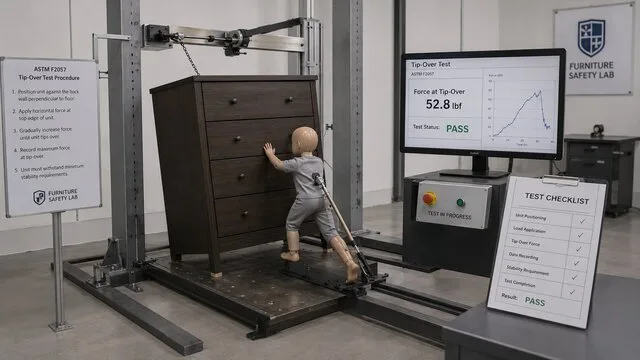
ASTM F2057 went from a voluntary industry standard to a federal compliance requirement when Congress passed the STURDY Act. That shift changed the risk profile for every US importer of clothing storage furniture — dressers, chests, bureaus, and door chests. What was previously a best practice became a legal obligation, and buyers who had not been tracking this change encountered it when retailers updated their compliance requirements.
Understanding what ASTM F2057 requires, what the STURDY Act changed, and how to verify compliance in a Southeast Asian supply chain is now a baseline sourcing competency for anyone importing residential clothing storage furniture to the US market.
What ASTM F2057 covers
ASTM F2057 is the Standard Safety Specification for Chests, Door Chests, Dressers, and Bureaus. It was developed in response to a documented pattern of clothing storage furniture tip-overs causing child fatalities and injuries. The standard establishes safety requirements focused on tip-over resistance — specifically, requiring that covered products either resist tip-over on their own under defined test conditions, or be supplied with wall-anchoring hardware that prevents tip-over when properly installed.
The standard applies to freestanding clothing storage furniture with one or more drawers or doors, intended for residential use. It covers the product category where tip-over risk has been most extensively documented through CPSC incident data.
What the STURDY Act changed
The Stop Tip-overs of Unstable, Risky Dressers on Youth (STURDY) Act directed the Consumer Product Safety Commission (CPSC) to issue a mandatory federal safety standard for clothing storage furniture. The CPSC finalized a rule based on ASTM F2057 requirements, making compliance mandatory rather than voluntary.
The practical effect: clothing storage furniture that does not meet the ASTM F2057 tip-over requirements cannot legally be sold in the US market. This is not a retailer-level requirement that can be negotiated — it is a federal safety regulation with product recall and civil penalty consequences for non-compliant goods. Retailers who sell clothing storage furniture in the US have updated their compliance requirements accordingly.
The tip-over test requirements
ASTM F2057 requires that covered furniture either pass a defined tip-over test or be supplied with compliant wall-anchoring hardware. The tip-over test evaluates the product under a simulated loading scenario representing a child climbing on an extended drawer — the most common mechanism in documented tip-over incidents. Products that tip under this test condition must be equipped with adequate wall-anchoring hardware.
The wall-anchoring option requires that the hardware be adequate for the weight and geometry of the product, that installation instructions be clear and complete, and that the hardware be included with the product at point of sale. Hardware adequacy is assessed by the test laboratory as part of the compliance evaluation.
Which products are in scope
The standard applies to chests, door chests, dressers, and bureaus — all freestanding clothing storage furniture with drawers or doors intended for residential use. Products with fixed, wall-mounted, or built-in configurations are generally outside scope. Buyers should verify in-scope classification for any clothing storage product category with their test laboratory before assuming a product is or is not covered.
Note that ASTM F2057 does not cover all residential furniture categories. CARB and TSCA formaldehyde emission requirements apply separately to any panel wood components in the same products.
Verifying compliance in the supply chain
ASTM F2057 compliance requires third-party test documentation from an accredited laboratory. Supplier declarations are not adequate. The test report must specify the product configuration tested, the test date, the laboratory, and the pass/fail result for tip-over and, if applicable, wall-anchoring hardware adequacy.
Buyers sourcing clothing storage furniture from Malaysia, Vietnam, or Indonesia need to confirm that each product configuration has been tested by an accredited lab against the current version of ASTM F2057, and that the tested configuration matches what is being produced. Configuration changes between prototype and production can affect tip-over test results.
If you are importing clothing storage furniture to the US and need to verify ASTM F2057 compliance for your Southeast Asian supplier, Top Systems Group can coordinate testing and documentation review before production sign-off.
Talk to our team →Non-compliance exposure
Non-compliant clothing storage furniture is subject to CPSC enforcement action including mandatory recalls, civil penalties, and retailer delisting. The consequences are not limited to the original importer — retailers who knowingly sell non-compliant products have their own exposure. This is an area where the compliance cost of getting documentation right upfront is far lower than the cost of a recall after distribution.
Key Takeaways
- ASTM F2057 covers tip-over safety for clothing storage furniture (chests, dressers, bureaus, door chests)
- The STURDY Act made ASTM F2057 compliance mandatory under federal law via a CPSC rule
- Products must either pass the tip-over test or be supplied with compliant wall-anchoring hardware
- Third-party test documentation from an accredited lab is required — supplier declarations are not adequate
- The tested configuration must match production — design changes after testing require re-evaluation
- Non-compliance exposes importers and retailers to CPSC enforcement, recalls, and civil penalties