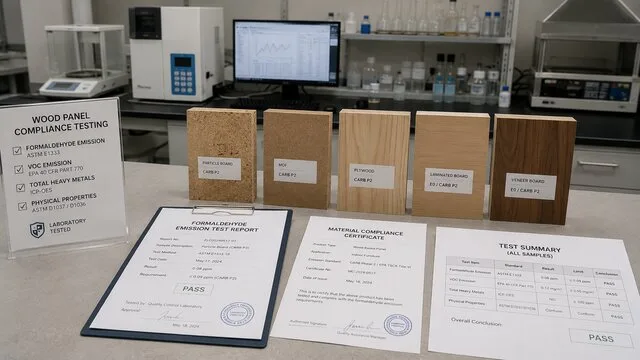
Formaldehyde emission compliance is one of the most consequential and least understood requirements in US furniture importing. Products that fail CARB or TSCA Title VI limits cannot legally enter the US market, cannot be sold through major retailers, and create significant liability exposure for the importer of record. Yet it remains an area where many buyers rely on supplier declarations rather than verified documentation.
Understanding what CARB and TSCA Title VI actually require, what products they apply to, and how compliance is properly documented is essential for any buyer sourcing wood furniture from Southeast Asia.
What CARB Phase 2 is
CARB Phase 2 refers to the second phase of the California Air Resources Board's Airborne Toxic Control Measure (ATCM) for formaldehyde emissions from composite wood products. It established emission limits for three composite wood panel types: hardwood plywood (HWPW), particleboard (PB), and medium density fiberboard (MDF).
Phase 2 limits are significantly more restrictive than Phase 1. For MDF — the most common panel material in flat-pack and ready-to-assemble furniture — the Phase 2 limit is 0.11 parts per million (ppm). For particleboard, it is 0.09 ppm. These limits apply to the panels themselves and to finished goods made from them.
What TSCA Title VI is
TSCA Title VI is the federal equivalent of CARB Phase 2. The Toxic Substances Control Act was amended by the Formaldehyde Standards for Composite Wood Products Act, which directed the EPA to establish national formaldehyde emission limits aligned with CARB Phase 2. The rule became fully effective for composite wood product manufacturers and importers in 2019.
TSCA Title VI applies nationwide — not just in California. A product that complies with TSCA Title VI meets the federal standard. CARB Phase 2 compliance is effectively equivalent, since the limits are aligned. In practice, a product with current third-party CARB Phase 2 certification satisfies TSCA Title VI requirements for emission limits.
Which products are in scope
Both CARB Phase 2 and TSCA Title VI apply to hardwood plywood, particleboard, and MDF used in finished goods, including furniture, flooring, and other products sold or distributed in the US. This means any furniture product containing these panel materials — whether manufactured domestically or imported — is subject to the emission limits.
The practical scope for Southeast Asian furniture sourcing is broad. Most flat-pack furniture uses MDF or particleboard for case goods, shelves, drawer bottoms, and cabinet carcasses. Almost any wood furniture product with panel components is in scope and requires verified compliance documentation.
How compliance is documented
Compliance must be certified by an EPA-accredited Third Party Certifier (TPC). Self-certification by suppliers is not adequate under either framework. The TPC system requires panel manufacturers to test their products against the emission limits, undergo periodic verification testing, and maintain documentation records that importers can reference.
For finished goods importers, the key documentation is: a valid TPC certificate for the panel materials used in the product, supply chain documentation tracing the panel materials to the certified manufacturer, and a product label or accompanying documentation confirming TSCA Title VI compliance. Major US retailers require this documentation as part of product onboarding and verify it during supplier audits.
What suppliers get wrong
The most common compliance error is a supplier declaration that materials are "CARB compliant" without providing TPC certificates, panel mill documentation, or chain-of-custody records. This is not adequate. A supplier's statement that their MDF supplier is CARB certified is not the same as documented, verifiable TPC certification traceable to the specific panel mill and manufacturing run.
Material substitution is another common risk. A factory that uses CARB-certified panels at the time of qualification may substitute uncertified materials from a different supplier when panel prices change. Factory audits and purchase order documentation reviews can catch these substitutions before goods are shipped.
If CARB and TSCA Title VI compliance documentation for your Southeast Asian supplier is incomplete or unverified, Top Systems Group can help establish the documentation chain and verify material compliance before production begins.
Talk to our team →Non-compliance consequences
Products that fail CARB or TSCA Title VI emission limits are subject to recall, penalties for the importer of record, and delisting from retail channels. The consequences of non-compliance — discovered either at the border or after retail distribution — are significantly more costly than the work required to verify compliance before production. This is an area where due diligence is unambiguously worth the investment.
Key Takeaways
- CARB Phase 2 and TSCA Title VI set federal formaldehyde emission limits for hardwood plywood, particleboard, and MDF
- TSCA Title VI applies nationwide; CARB Phase 2 limits are aligned and compliance with one satisfies the other
- Virtually all furniture containing composite wood panels is in scope and must be documented
- Compliance requires certification by an EPA-accredited Third Party Certifier — supplier declarations are not adequate
- Documentation must include TPC certificates, panel mill records, and chain-of-custody traceability
- Material substitution after qualification is a common risk requiring active supply chain monitoring