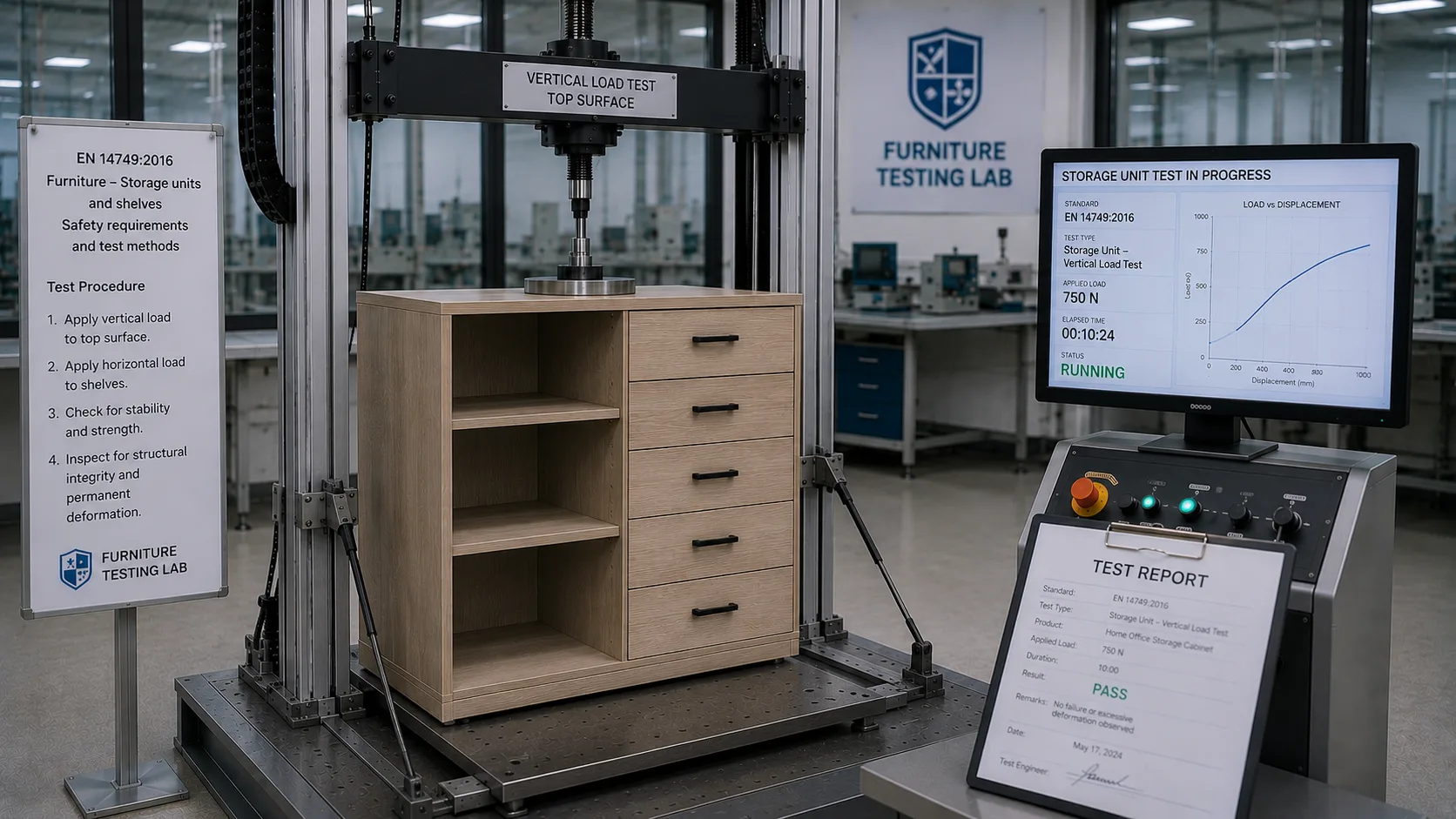
BIFMA X6.5-2022 is the current BIFMA standard for home office and occasional-use furniture products. It is not the same as BIFMA X5.1 or X5.5, which govern commercial-duty seating and desk products. It is not the legacy ANSI/SOHO standard that predates it. It is the most current formal performance framework for residential-grade furniture products sold for home office or light-duty use environments.
Buyers who are clear on what X6.5 is — and what it is not — can use it effectively. Buyers who treat it as interchangeable with commercial BIFMA standards create qualification gaps that become visible when products fail in their intended deployment context.
What BIFMA X6.5-2022 covers
BIFMA X6.5-2022 covers desks, tables, and storage products designed for home office and occasional-use environments. It was published in 2022, replacing earlier frameworks that addressed this product category with less comprehensive test methodologies.
The standard applies to products that are intended for residential use or light commercial deployment where use frequency and loading are significantly lower than traditional commercial office environments. It establishes performance requirements appropriate for that use context — not performance requirements appropriate for task-intensive commercial environments.
How the test parameters differ from commercial BIFMA standards
The key difference between X6.5 and commercial BIFMA standards like X5.5 (desks) is the duty cycle. Commercial standards are designed around products that will be used heavily, day after day, by multiple users over many years. X6.5 is designed around lower-frequency use by one or a small number of users in a residential context.
This means X6.5 uses lower cycle counts in fatigue tests, lower load thresholds in some structural tests, and test conditions calibrated to the residential deployment context rather than the commercial office context. A product qualified under X6.5 may perform well in a home office and perform inadequately in a commercial setting — not because it is a poor product, but because it was qualified against the wrong standard for the commercial use case.
When X6.5 is the right standard
X6.5 is appropriate when the product is genuinely intended for home office or occasional-use environments, when the buyer's procurement specification permits it, and when the tested product configuration matches what is being sourced. For brands selling direct-to-consumer home office furniture, X6.5 is a more accurate qualification baseline than commercial BIFMA standards that overstate what residential deployment actually demands.
It is also appropriate as a replacement for the legacy ANSI/SOHO S6.5 standard for suppliers updating their certification portfolio. X6.5 was developed under the established BIFMA standards process and provides a more current and defensible technical basis for home office product qualification.
When X6.5 is not adequate
X6.5 is not adequate for commercial deployment, institutional procurement, or any environment where furniture will be used at commercial-duty frequency. Buyers sourcing for contract office environments, co-working spaces, institutional settings, or commercial hospitality should require X5.5 or X5.1 as appropriate — not X6.5.
One of the most common supplier qualification errors is presenting X6.5 as equivalent to commercial BIFMA when a commercial-grade product is required. US retailers and institutional buyers are increasingly explicit about which standard applies to which product category. Buyers who do not specify clearly allow suppliers to default to the easier qualification path.
If you are qualifying home office furniture products from Southeast Asia and need to confirm whether X6.5 is the right standard for your use case, Top Systems Group can assess the alignment between your product, your market, and the appropriate certification baseline.
Talk to our team →What X6.5 does not tell buyers
A BIFMA X6.5 reference does not confirm emission compliance, finish durability, packaging performance, or suitability for commercial deployment. It does not validate ergonomic specifications or height adjustability compliance. These are separate qualification tracks that must be documented independently alongside the X6.5 structural performance reference.
The most defensible qualification approach for home office products combines X6.5 structural performance documentation with CARB/TSCA emission compliance, finish testing appropriate to the expected cleaning environment, and packaging performance validation. X6.5 alone is not a complete qualification package.
Key Takeaways
- BIFMA X6.5-2022 covers desks, tables, and storage products for home office and occasional-use environments
- It uses lower duty cycle test parameters than commercial BIFMA standards — appropriate for residential use
- It is the current replacement for the legacy ANSI/SOHO S6.5 standard in this product category
- It is not adequate for commercial deployment, institutional procurement, or high-frequency use environments
- Buyers must specify the correct standard in qualification documents to prevent supplier substitution
- X6.5 alone is not a complete qualification package — emission compliance and finish testing must be documented separately