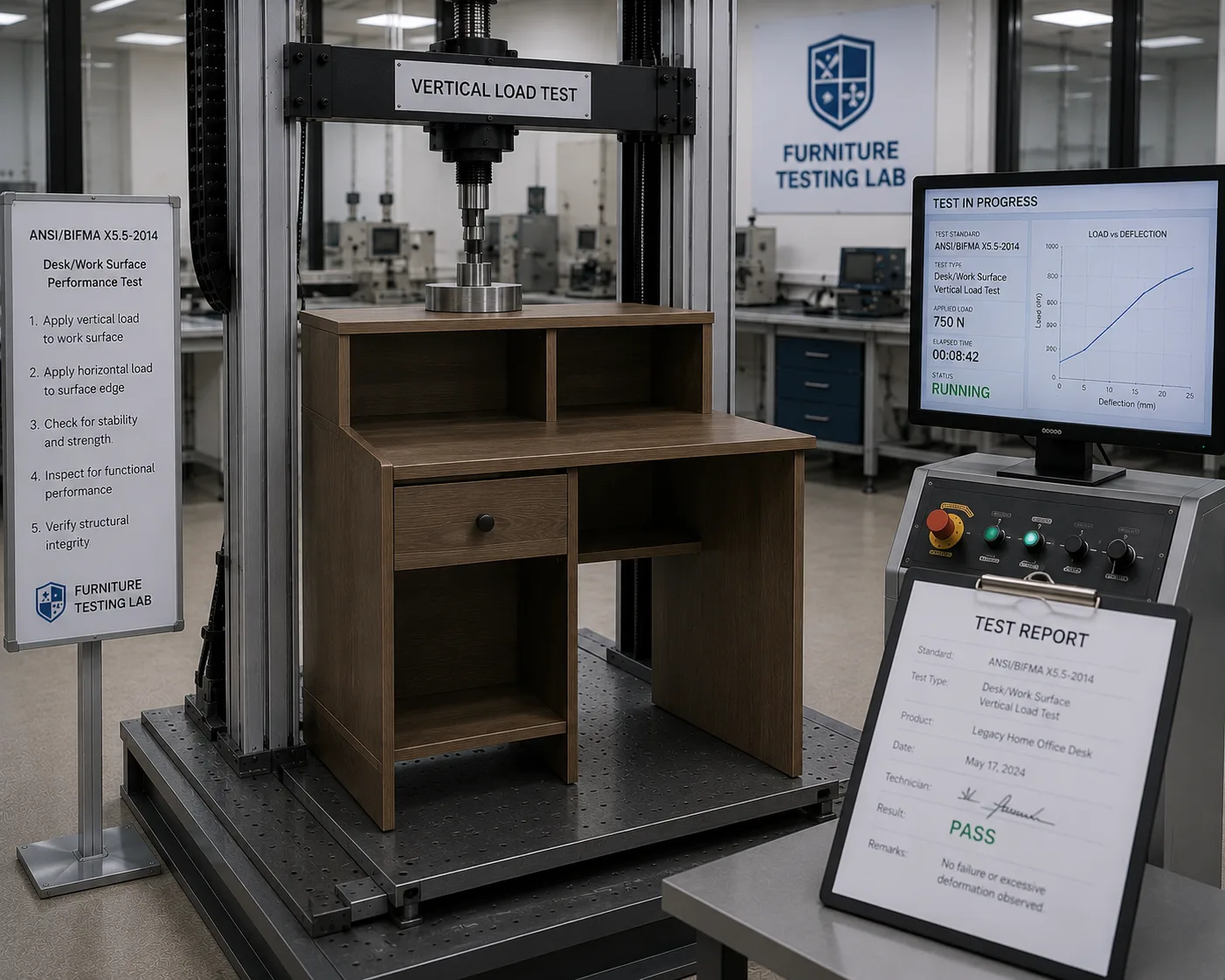
ANSI/SOHO S6.5-2008 still appears in supplier documentation. That surprises some buyers. A standard first published in 2008 and reaffirmed in 2013 may seem like a relic. But understanding why it persists — and what it was designed to cover — is relevant for anyone sourcing home office furniture products in 2024.
The short version: ANSI/SOHO S6.5 was one of the first formal standards to address the small office and home office product category. It filled a real gap. It has since been largely superseded by more current frameworks, but it continues to appear in supplier documents because factories qualified against it years ago and have not always updated their certification portfolio.
What ANSI/SOHO S6.5 was designed to cover
ANSI/SOHO S6.5 was published to address furniture products intended for use in small office and home office environments — a category that did not fit cleanly into commercial BIFMA standards or residential product standards. The 2008 edition established performance requirements for desks, computer furniture, and storage products in this use context. The 2013 reaffirmation confirmed the standard remained technically current without substantive changes to the test requirements.
The key design intent was to create a performance baseline appropriate for the lower duty cycle of home office use — less intensive than commercial office environments but more structured than no standard at all.
How it differs from current BIFMA frameworks
ANSI/SOHO S6.5 predates BIFMA's own home office product frameworks. BIFMA X6.5-2022 now provides a more current and comprehensive standard for home office and occasional-use furniture products developed under the established BIFMA standards development process.
The differences are not trivial. BIFMA X6.5 was developed with more recent use research, more current test methodologies, and better alignment with how home office furniture is actually deployed and loaded in modern households. ANSI/SOHO S6.5 remains technically valid but is no longer the preferred reference for new product development or procurement specifications.
Why it still appears in supplier documents
Suppliers in Malaysia, Vietnam, and Indonesia who qualified their home office product lines against ANSI/SOHO S6.5 in 2012 or 2015 may still reference that certification in their capability documentation. Testing costs money. Re-qualification against a newer standard requires time and resources. Many factories default to maintaining existing certifications unless a buyer specifically requires an updated reference.
This is not fraud — ANSI/SOHO S6.5 is a legitimate published standard. But it does mean buyers need to ask the right questions. Is the supplier referencing SOHO because it is appropriate for the use case, or because it is the oldest and cheapest certification in the portfolio?
When ANSI/SOHO S6.5 is and is not appropriate
ANSI/SOHO S6.5 may still be an acceptable reference if your product is clearly positioned for home office or occasional-use residential environments, if no current retailer or institutional buyer requirement specifically mandates BIFMA X6.5, and if the tested product configuration still matches what you are sourcing. It becomes inadequate when a buyer is sourcing for commercial deployment, when retailer specifications require current BIFMA references, or when the standard is being used to imply broader commercial-use qualification than it was ever designed to support.
The qualification question is not which standard sounds more current. It is whether the standard matches the intended use context and the buyer's actual procurement requirements. For many buyers, qualifying suppliers in Malaysia against BIFMA X6.5 now is the cleaner path forward.
What it does not tell buyers
An ANSI/SOHO S6.5 reference does not confirm emission compliance, packaging performance, finish durability, or commercial-duty suitability. It addresses performance within the scope of the home office use context the standard was written for. Buyers who treat it as a broad quality endorsement are misreading its scope.
If a supplier is referencing ANSI/SOHO S6.5 for a product you are qualifying, Top Systems Group can help assess whether that reference matches your use case and whether updated certification is needed.
Talk to our team →Treat legacy standards as context, not current compliance
ANSI/SOHO S6.5 has value as context — it tells you something about when a product line was last formally qualified and against what framework. It becomes a problem when it is used as a substitute for current compliance documentation in a procurement process that requires up-to-date references.
Buyers who specify their certification requirements explicitly before production begins do not discover these gaps after delivery. That is the right time to resolve them.
Key Takeaways
- ANSI/SOHO S6.5-2008 (R2013) is a legacy standard for small office and home office furniture products
- It was one of the first formal standards in this product category and filled a real market need
- It has been largely superseded by BIFMA X6.5-2022 for home office product qualification
- It still appears in supplier documents because re-qualification is not automatic when standards are updated
- It is not adequate for commercial-deployment products or buyers who require current BIFMA references
- Buyers should specify certification requirements explicitly rather than accepting whatever the supplier has on file