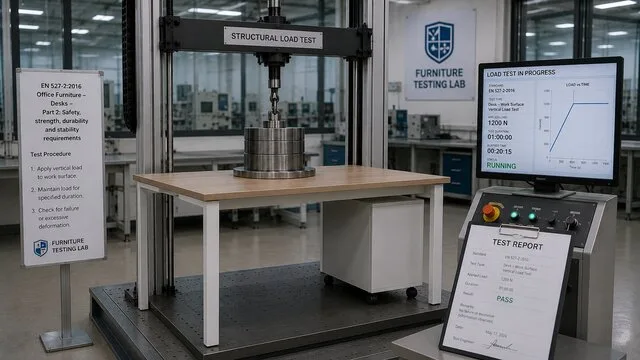
BIFMA X5.5 is the performance standard that governs commercial desk products. It is less cited than BIFMA X5.1 — which covers seating — but it is equally relevant for buyers sourcing case goods and work surface products for commercial environments. Misreading what X5.5 covers creates exactly the kind of qualification gaps that lead to retailer rejections and post-delivery claims.
Understanding what X5.5 tests, how it is structured, and what it cannot tell you about a product's commercial suitability gives buyers a stronger basis for evaluating supplier claims and setting appropriate test requirements before production begins.
What BIFMA X5.5 covers
BIFMA X5.5 is the ANSI/BIFMA standard for desk products in commercial office environments. The 2014 edition applies to freestanding desk units, return units, corner units, and similar work surface products designed for commercial-duty use. It establishes minimum performance requirements for products expected to function reliably under typical office conditions over an extended product life cycle.
The standard is product-focused, not use-environment-focused. It defines what the physical product must be capable of — not what environment it will be placed in. That distinction matters because buyers sometimes conflate passing X5.5 with suitability for their specific deployment context.
The key tests in X5.5
BIFMA X5.5 covers a range of structural and functional tests, including:
- top surface static load — evaluating the work surface under concentrated and distributed loads
- top surface impact — drop and impact resistance for the work surface
- leg and base structural integrity — pull and push tests on leg assemblies
- stability — assessing tipping risk under representative loading conditions
- drawer operation and cycling — evaluating drawer mechanism durability under repeated use
- file drawer capacity — structural performance under fully loaded file drawer conditions
- rolling load — caster and wheel load performance on mobile desk components
Each test is designed to reflect the conditions a commercial desk product should reasonably be expected to withstand during normal office use over its intended service life.
What X5.5 does not validate
Passing BIFMA X5.5 does not confirm surface finish quality, cleanability, formaldehyde emission compliance, packaging performance, or cosmetic consistency. It does not confirm that the product meets CARB or TSCA Title VI emission limits for composite wood components. These are separate qualification requirements that must be documented independently.
X5.5 also does not cover ergonomic suitability, height adjustability compliance, or electrical integration. A desk can pass all X5.5 tests and still fail retailer-specific requirements or end-user ergonomic specifications.
X5.5 versus home office standards
A common qualification error is substituting BIFMA X6.5 (home office and occasional-use desk products) for BIFMA X5.5 when a product is intended for commercial deployment. X6.5 uses lower duty cycle test parameters appropriate for residential and occasional-use environments. It is not a substitute for X5.5 in commercial procurement.
Similarly, ANSI/SOHO S6.5 is a legacy home office standard that predates the BIFMA X6.5 framework. Suppliers who reference SOHO standards for commercial desk products are using the wrong qualification baseline.
Using X5.5 in supplier qualification
The most useful qualification question is not "does this product have BIFMA?" It is "which BIFMA standard was used, what product configuration was tested, and when?" Test reports should specify the standard version, the tested configuration, the test laboratory, and the test date. A report that references only "BIFMA compliant" without specifics is not useful for commercial procurement.
Buyers who include X5.5 test report requirements in their factory qualification process catch substitution issues before production, not after delivery.
If BIFMA X5.5 compliance is a requirement for your desk product category, Top Systems Group can help verify that supplier test documentation matches the product configuration you are actually sourcing.
Talk to our team →What X5.5 compliance actually tells you
BIFMA X5.5 compliance tells you that the tested product configuration met defined structural and functional performance thresholds under the test conditions specified by the standard. It is a useful baseline qualification signal. It is not a broad endorsement of product quality, finish durability, emission compliance, or commercial suitability for every deployment context.
Used correctly, X5.5 is one component of a complete commercial qualification framework — not a substitute for it.
Key Takeaways
- BIFMA X5.5 governs commercial desk products and covers structural and functional performance tests
- It tests top surface loads, impact, stability, drawer cycling, and leg integrity
- Passing X5.5 does not confirm emission compliance, finish quality, or packaging performance
- X5.5 is not interchangeable with BIFMA X6.5 or ANSI/SOHO for commercial procurement
- Test reports must specify the standard version, configuration tested, lab, and test date
- X5.5 is a baseline qualification signal, not a comprehensive product quality endorsement