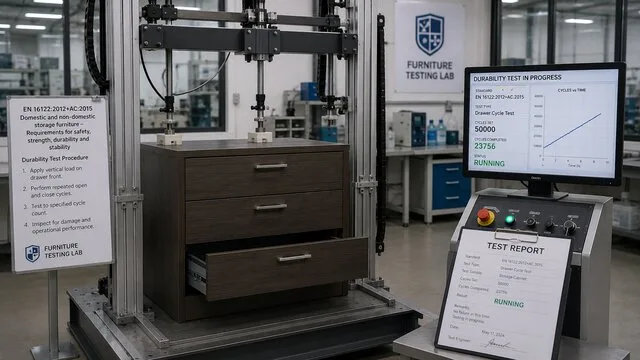
Storage units are one of the most claims-prone furniture categories in commercial procurement. File cabinets that tip under load, drawer mechanisms that fail after minimal cycling, shelves that sag under standard office loads — these failures are predictable, and they are preventable. BIFMA X5.9-2019 provides the performance framework that defines what commercial storage units should be capable of withstanding.
Buyers who understand what X5.9 tests — and what it does not — can use it to set meaningful qualification requirements and catch inadequate products before they reach a warehouse or a customer's office.
What BIFMA X5.9-2019 covers
BIFMA X5.9-2019 is the ANSI/BIFMA standard for storage units used in commercial office environments. It applies to freestanding storage products including filing cabinets, bookcases, credenzas, pedestals, lateral files, and similar case goods designed for commercial-duty use.
The 2019 edition updated the earlier version of the standard to reflect current commercial storage use conditions and improve the clarity of test requirements. It establishes minimum performance thresholds for products expected to function reliably under typical commercial office loading and operating conditions across an extended product lifecycle.
Key tests in X5.9
The standard covers a comprehensive range of structural and functional tests relevant to storage products in commercial use:
- drawer pull and cycling — evaluating drawer mechanism durability under repeated open-close cycles with load
- overturning stability — assessing tipping risk when drawers are extended under load
- shelf load capacity — structural performance of fixed and adjustable shelves under representative loads
- file drawer capacity — performance under fully loaded hanging file conditions
- top surface load — structural integrity of the cabinet top under concentrated and distributed loads
- base and leg integrity — structural performance of the cabinet base and support structure
- interlock mechanism — for cabinets with anti-tipping interlocks, verification that the mechanism functions correctly
The overturning stability test is particularly important. Storage units with multiple drawers can become dangerously unstable when a heavily loaded drawer is fully extended. The standard defines the conditions under which this risk must be evaluated and what constitutes adequate performance.
What X5.9 does not cover
BIFMA X5.9 does not address emission compliance. Storage units with MDF, particleboard, or plywood components must also comply with CARB Phase 2 and TSCA Title VI formaldehyde emission limits. These are separate compliance requirements with separate documentation needs.
X5.9 also does not validate finish quality, cosmetic consistency, packaging performance, or electronic integration. A storage unit that passes all X5.9 structural tests can still fail on surface finish quality, hardware finish consistency, or packaging adequacy during transit. Those must be addressed through separate quality protocols.
X5.9 versus residential storage standards
Residential and home office storage products are governed by different standards. BIFMA X6.5-2022 covers storage products for home office and occasional-use environments at lower duty cycle parameters. Buyers sourcing for commercial deployment should not accept X6.5 as a substitute for X5.9.
ASTM F2057 addresses a different safety concern — tip-over prevention for clothing storage furniture (dressers, chests) in residential contexts. It is not a substitute for X5.9 in commercial storage procurement.
Using X5.9 in supplier qualification
The most effective qualification approach is to include specific X5.9 test report requirements in the factory qualification document before production is committed. Suppliers should be asked for test reports that specify the standard version, the exact product configuration tested, the test laboratory, and the test date. A vague "BIFMA compliant" claim without supporting documentation is not adequate.
Factory audits in Southeast Asia should verify that the supplier's actual production process and materials match the configuration that was tested — material substitutions after certification are a common source of performance failures.
If you are sourcing commercial storage units from Southeast Asia and need to verify X5.9 compliance, Top Systems Group can review test documentation and assess whether the certified configuration matches your production specification.
Talk to our team →What X5.9 compliance tells you
X5.9 compliance tells you that the tested product configuration met defined structural and functional performance thresholds appropriate for commercial storage use. It is a meaningful qualification signal. It is not a comprehensive product quality endorsement, and it does not replace emission compliance documentation, finish quality verification, or packaging performance validation.
Storage units are a high-claim category in commercial furniture sourcing. Buyers who specify X5.9 requirements clearly and verify documentation before production are ahead of those who discover compliance gaps after delivery.
Key Takeaways
- BIFMA X5.9-2019 covers commercial storage units including file cabinets, bookcases, and credenzas
- Key tests include drawer cycling, overturning stability, shelf load capacity, and drawer capacity under load
- Overturning stability under extended loaded drawers is a critical safety test in the standard
- X5.9 does not replace CARB/TSCA emission compliance for composite wood components
- X6.5 is not an adequate substitute for X5.9 in commercial storage procurement
- Test reports must specify configuration tested, lab, version, and date to be useful in procurement