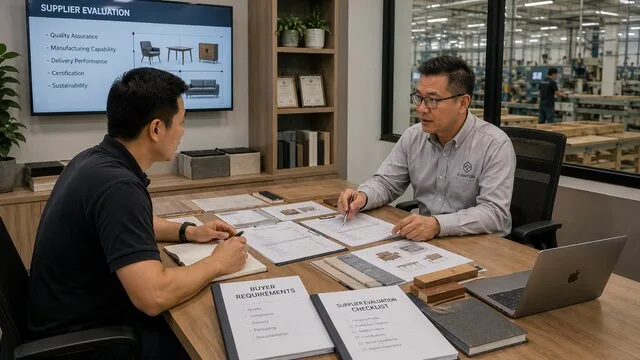
The standard narrative in furniture sourcing places all the qualification risk on one side: the buyer evaluating the factory. That narrative is incomplete. Good factories in Malaysia, Vietnam, and Indonesia qualify buyers too — and the ones that do not want your business are often the ones you most want to work with.
Understanding what makes a factory decline a buyer relationship is not just interesting context. It is actionable intelligence about what you need to bring to the table to access the best manufacturing partners in Southeast Asia.
Why factories have the leverage to be selective
A well-run furniture factory with strong product development capability, clean compliance documentation, and a track record of on-time delivery to US and European brands is not starving for orders. It has options. Its production calendar books months in advance. Its existing customers value the relationship and renew orders. When a new buyer approaches, the factory is evaluating whether the relationship will be worth the disruption.
This is particularly true in Malaysia, where the established furniture manufacturing industry includes factories with 20 or more years of experience serving major international brands. These factories have seen enough difficult buyer relationships to know the patterns that predict problems.
What signals a bad buyer to a factory
The signals factories watch for are consistent. Unrealistic pricing expectations — asking for commercial-grade products at price points that do not support the material and labor cost structure — signal a buyer who either does not understand the market or is shopping for shortcuts. Both are problems.
Incomplete specifications signal a buyer who is not ready to commit. A factory cannot quote accurately, plan production efficiently, or hold quality to a standard that has not been defined. Buyers who arrive without clear technical drawings, material specifications, and finish standards create rework cycles and specification disputes that cost everyone money.
Excessive sampling requests without commitment are another pattern factories recognize. Some buyers run a factory through five or six sample rounds, refining specifications, building the factory's technical knowledge of the product — and then take everything they have learned to a cheaper factory. The producing factory absorbed all the development cost and got nothing. Once a factory has been treated this way, they start asking for sample fees and qualifying buyer seriousness before investing development time.
Payment and commercial behavior matters
Factories talk to each other, especially within the networks that characterize the furniture manufacturing clusters in Johor Bahru, Ho Chi Minh City, and Jepara. A buyer with a reputation for slow payment, disputed invoices, or last-minute cancellations after production is committed will find that reputation precedes them. Reference checking works both ways.
A buyer who can demonstrate a clean payment history, a reasonable deposit structure, and a track record of honoring purchase commitments is a buyer factories want to grow with. The supplier qualification process is also a buyer presentation process.
Volume and growth trajectory signal commitment
A factory with significant minimum order quantities is not being arbitrary. It is protecting its production economics. Setting up a new product line, training operators, sourcing materials, and managing quality for a 200-unit order is nearly as expensive as doing it for a 2,000-unit order — but the revenue does not justify the investment at 200 units. Buyers who cannot meet MOQ or who offer trial orders too small to be economically rational for the factory are signaling a relationship that will not scale.
Conversely, a buyer who arrives with a realistic volume projection, a clear product roadmap, and evidence of existing distribution is signaling a relationship worth investing in.
The compliance and standards expectations are rising
The best factories in Malaysia and Vietnam are investing in quality systems, compliance documentation, and social compliance audits because they are building relationships with buyers who require them. They are not interested in buyers who want to avoid documentation requirements because it slows things down or adds cost. Those factories have already filtered out that buyer profile.
Top Systems Group works with buyers to present their sourcing requirements in the way that resonates with the best factories in Malaysia, Vietnam, and Indonesia — and to qualify factories that are genuinely the right fit.
Talk to our team →Being the buyer factories compete for
The practical implication is that buyers who bring clear specifications, realistic pricing expectations, reasonable MOQ commitments, clean commercial behavior, and a professional qualification process will find themselves in a different tier of factory conversations than buyers who do not. The factories you want to work with are evaluating whether you are the buyer they want to work with.
That is not a problem to solve by finding cheaper factories. It is an opportunity to improve how you show up in the market.
Key Takeaways
- Well-run factories in Southeast Asia are selective — they evaluate buyer quality, not just the other way around
- Unrealistic pricing, incomplete specifications, and excessive sampling without commitment are red flags to good factories
- Payment history and commercial behavior reputation travel through manufacturing networks
- Volume commitments and growth trajectory signal whether a relationship is worth investing in
- Factories building compliance capability are not interested in buyers trying to avoid documentation requirements
- Presenting professionally with clear specs and realistic expectations puts buyers in a different tier of factory access