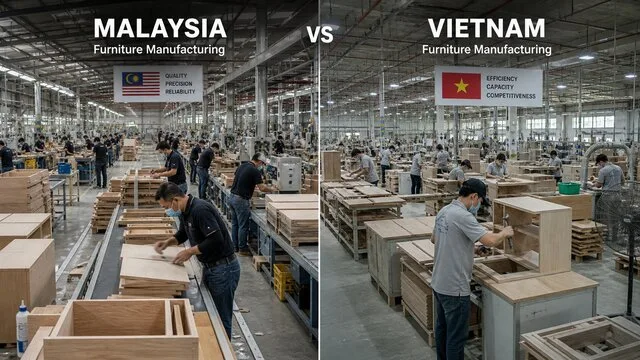
Malaysia and Vietnam are the two most significant furniture manufacturing destinations in Southeast Asia for US buyers. They are not interchangeable. Each market has distinct strengths, cost structures, compliance environments, and risk profiles that matter differently depending on your product category, volume, compliance requirements, and market channel.
This is a practical comparison for US buyers evaluating which market makes more sense for their specific sourcing program — not a ranking of which country is better, but a structured view of the dimensions that actually determine fit.
Cost structure
Vietnam has lower labor costs than Malaysia, particularly for labor-intensive production processes like upholstery, hand-finishing, and detailed assembly work. This cost advantage is real and is one of the primary reasons Vietnam has grown significantly as a furniture export market over the past decade.
Malaysia has higher labor costs but also higher productivity in many areas, stronger infrastructure, and an established hardwood and panel board industry that reduces material sourcing lead times and costs for wood furniture. For products where material cost is a larger proportion of total cost than labor — solid wood furniture, higher-end case goods — the Malaysian cost structure may be more competitive than the raw labor cost comparison suggests.
Product category strengths
Malaysia's strengths are concentrated in: solid wood furniture (rubberwood, meranti, and plantation teak are well-established in Malaysian production), panel furniture and case goods, commercial and contract furniture, and custom product development for complex specifications.
Vietnam's strengths are in: upholstered goods (sofas, dining chairs, bedroom upholstery), flat-pack ready-to-assemble products, and high-volume production of mid-range case goods. Vietnam's furniture export industry has grown quickly and now includes factories with sophisticated quality management systems and compliance documentation capability.
Compliance environment and documentation
Malaysia has a longer history of formal quality system adoption, social compliance auditing, and export-oriented compliance documentation. The furniture manufacturing clusters in Johor Bahru and Muar have been serving US and European retail supply chains for 20+ years, and the compliance infrastructure — third-party testing labs, certification bodies, audit organizations — is well-developed.
Vietnam has invested heavily in compliance capability over the past decade and many Vietnamese factories now have current CARB/TSCA, BIFMA, and social compliance documentation. However, the range of compliance capability is wider in Vietnam — factories at the top tier are excellent, while factories selected through purely price-driven processes may have significant documentation gaps.
Section 301 tariff risk
Vietnam faces ongoing scrutiny regarding China-origin components in furniture manufactured for US export. The Section 301 tariffs on Chinese furniture created strong incentives to shift production to Vietnam, but US Customs enforcement has been active in examining whether Vietnamese furniture has sufficient local value-added content to qualify as Vietnamese-origin rather than Chinese-origin transshipment. Buyers sourcing from Vietnam need to understand their factory's supply chain for key components — panels, hardware, foam — and whether any Chinese-origin inputs create origin declaration risk.
Malaysia has lower China-origin supply chain exposure in its furniture production and is generally considered lower-risk from a US Customs origin perspective, though buyers should still review material sourcing documentation as part of factory qualification.
Infrastructure and lead times
Malaysia has better road infrastructure, more reliable port logistics (Port Klang is one of Southeast Asia's major transshipment hubs), and more consistent power supply than many Vietnamese manufacturing areas. These infrastructure advantages translate to more predictable lead times and lower logistics cost variability for time-sensitive production programs.
Vietnam's infrastructure has improved significantly, particularly around Ho Chi Minh City, but factory location relative to port matters more in Vietnam than in Malaysia, and lead time risks during holiday periods — particularly Tet — are more pronounced in Vietnam than in Malaysia.
English language and business culture
Malaysia's business environment is English-language-fluent, with a Chinese-Malaysian business community that has extensive experience working directly with US and European buyers. Technical discussions, specification reviews, and compliance documentation are routinely conducted in English without interpretation. This reduces friction in product development and qualification, particularly for buyers who are newer to Southeast Asian sourcing.
Vietnam requires more active translation and interpretation in factory-level conversations, and business culture differences can affect communication clarity in specification discussions. This is manageable with the right sourcing support, but it is a real difference in operational friction.
Top Systems Group works across Malaysia, Vietnam, and Indonesia — and can help buyers understand which market is the right fit for their specific product category, compliance requirements, and volume profile.
Talk to our team →Making the market decision
The right market for your sourcing program depends on your product category, compliance requirements, volume, and operational tolerance for market-specific risks. Malaysia is typically the stronger fit for solid wood furniture, complex product development, compliance-intensive procurement, and buyers who are earlier in their Southeast Asian sourcing experience. Vietnam is typically the stronger fit for upholstered goods, high-volume flat-pack production, and buyers with established supply chain oversight capability who can manage the compliance verification work actively.
Many experienced buyers source from both markets, matching product categories to the market where the combination of capability, cost, and risk management is most favorable.
Key Takeaways
- Malaysia has higher labor costs but stronger infrastructure, compliance environment, and English-language business culture
- Vietnam has lower labor costs and strong upholstered furniture capability but wider variance in factory compliance maturity
- Section 301 tariff risk from China-origin components is a specific risk to manage in Vietnamese supply chains
- Malaysia's port infrastructure and holiday calendar make lead times more predictable than Vietnam for many product categories
- The right market choice depends on product category, compliance requirements, volume, and supply chain oversight capability
- Many experienced buyers use both markets, matching each product category to where the capability-cost-risk combination is most favorable