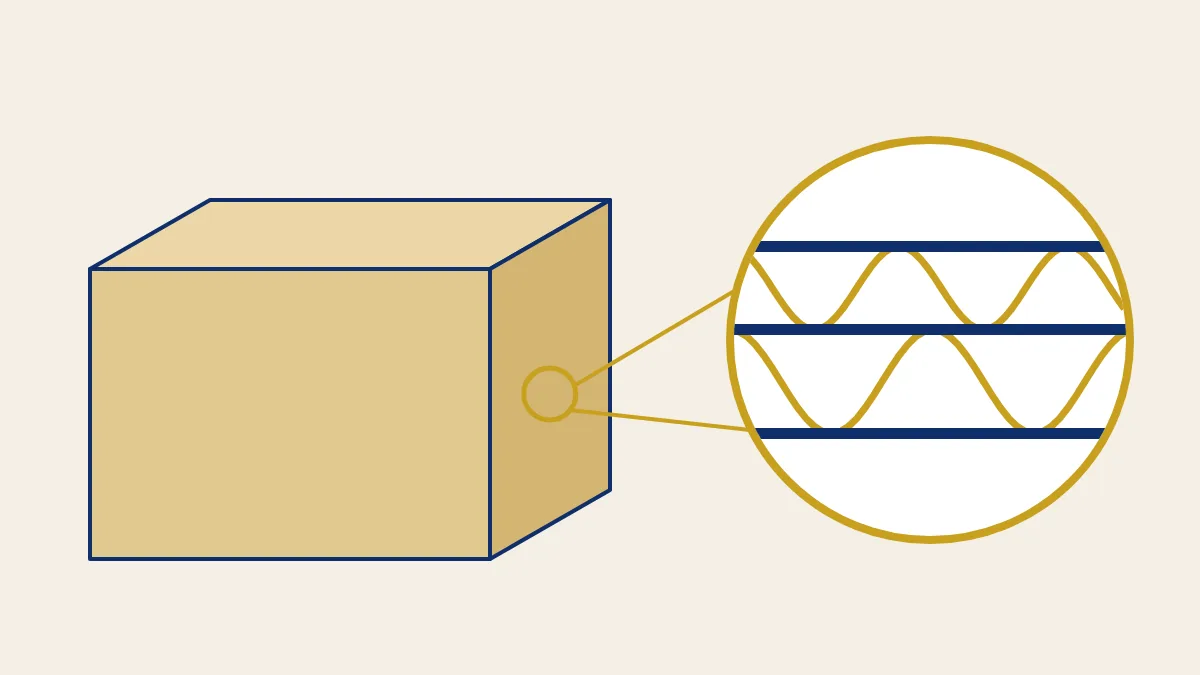
Say two factories quote the same flat-pack TV stand, and both write “5-ply carton” on the quotation. It sounds like the packaging is settled. It isn’t. “5-ply” tells you how many papers are in the board. It says nothing about which flutes they form, how heavy or strong each paper is, how well the layers are bonded, or how the box will hold up after weeks in a humid warehouse and an ocean container.
So two cartons that are both honestly “5-ply” can test very differently. This article explains where the difference comes from, how US buyers usually put a number on it, and what to check before you approve a carton, or a change to one.
What “5-ply” actually means
A 5-ply board has five papers: three flat liners and two fluted layers between them. The fluted paper is called the medium, and its wave shape is what gives the board its stiffness. In North America the same board is called double wall. A 3-ply board is single wall, and a 7-ply board is triple wall.
The board is the same everywhere. The words used for it are not. In Malaysia, Vietnam and Indonesia you will usually hear “5-ply”. A US carton specification says “double wall” and gives an edge crush (ECT) or burst rating. European suppliers add a flute code such as BC or EB and describe the liners as kraft or testliner. When a buyer, a factory and a test lab each use a different vocabulary, it is easy to agree on the word “5-ply” and still mean different boards.
Five layers, many possible boards
At least four things can change while the ply count stays at five.
The flute combination
Flutes are named by letter. The letters follow the order in which the profiles were introduced, not their size, so B is smaller than C. Common nominal heights are about 3/16 in (4.8 mm) for A flute, 5/32 in (4.0 mm) for C, 1/8 in (3.2 mm) for B and 1/16 in (1.6 mm) for E. Actual board caliper varies by mill.
Put two of them together and you get a double-wall combination. BC is the familiar heavy shipping board. EB is much thinner. The packaging maker DS Smith describes BC as the choice for compression and stacking strength and EB as strong, more printable and taking much less storage space than BC. Neither is “better” in general. They are built for different jobs.
Which flute faces out
In BC board the B flute is normally on the outside and the C flute on the inside. The smaller flute gives a smoother surface for printing. Ask for the board to be described layer by layer, starting from the outside, so there is no doubt about which flute and which paper sits where.
The paper in each layer
Liners are either kraft liner, made from softwood pulp, or testliner, made from recycled paper. In most standard cartons the fluting is recycled paper too. Each paper also has a weight, given in grams per square meter (GSM). Two cartons can both be “5-ply BC” and still differ in every one of these choices:
| Layer, outside to inside | Carton A | Carton B |
|---|---|---|
| Outer liner | Kraft, 200 GSM | Testliner, 150 GSM |
| First flute | Medium, 120 GSM | Medium, 100 GSM |
| Middle liner | Testliner, 150 GSM | Testliner, 125 GSM |
| Second flute | Medium, 120 GSM | Medium, 100 GSM |
| Inner liner | Testliner, 150 GSM | Testliner, 125 GSM |
These numbers are made up to show the idea. They are not a recommendation, and nobody can tell from this table how much stronger Carton A is. Heavier paper does not automatically mean a stronger board: fiber quality, recycled content and moisture all change the result. Only a test answers the question.
How the board is made and converted
The layers are glued on the corrugator, then the sheets are printed, slotted, scored and folded into boxes. Weak bonding lets layers separate under load. Flutes partly crushed during printing or converting lose strength the paper recipe would have given them. None of this is visible from the words “5-ply”.
How US buyers put a number on the same board
US carton specifications rarely mention ply count. They give a rating, usually either an edge crush test (ECT) value in pounds per inch of width or a burst value in pounds per square inch. Many trace back to the carrier classification rules, NMFC Item 222 for motor carriers and Rule 41 of the Uniform Freight Classification for rail. Under these rules a box maker can certify either a burst rating or, as an alternative, an ECT rating. The certification appears as a round Box Manufacturer’s Certificate printed on the box, showing the number of walls, the rating, the maximum gross weight and the maximum size.
The double-wall rows of the Item 222 table, as published in carriers’ packaging guides, show how wide “double wall” really is. Item 222 is still in force, but check the current NMFC edition before you put a number in a specification.
| Max. box and contents | Max. length + width + depth | Min. ECT | or min. burst |
|---|---|---|---|
| 80 lb (36 kg) | 85 in (216 cm) | 42 lb/in (7.4 kN/m) | 200 psi (1,379 kPa) |
| 100 lb (45 kg) | 95 in (241 cm) | 48 lb/in (8.4 kN/m) | 275 psi (1,896 kPa) |
| 120 lb (54 kg) | 105 in (267 cm) | 51 lb/in (8.9 kN/m) | 350 psi (2,413 kPa) |
| 140 lb (64 kg) | 110 in (279 cm) | 61 lb/in (10.7 kN/m) | 400 psi (2,758 kPa) |
| 160 lb (73 kg) | 115 in (292 cm) | 71 lb/in (12.4 kN/m) | 500 psi (3,447 kPa) |
| 180 lb (82 kg) | 120 in (305 cm) | 82 lb/in (14.4 kN/m) | 600 psi (4,137 kPa) |
Every row is double wall, which is to say 5-ply. The minimum ECT runs from 42 to 82 pounds per inch, almost double from the first row to the last. That is the same point as the rest of this article, written in the carrier’s own numbers.
Two practical notes. Test reports from Asian and European labs usually give ECT in kN/m; multiply by 5.71 to get pounds per inch. And Item 222 is a carrier’s minimum for accepting freight. Retailers can set their own carton rules, and meeting any of them does not prove a particular piece of furniture will arrive undamaged.
ECT, burst and box compression measure different things
The three numbers most often quoted for a carton are not interchangeable. Each one loads the board in a different direction.
| Test | What it measures | What it does not prove |
|---|---|---|
| Edge crush (ECT) ISO 3037, TAPPI T 811 | How much load a short strip of board carries on its edge before it crushes. It is the board value used to estimate a box’s stacking strength (the McKee estimate). | How a filled, damp or unusually shaped box will stack. The usual estimate from ECT to box strength was developed for empty single-wall regular slotted boxes. |
| Burst (Mullen) TAPPI T 810 | The pressure needed to rupture the board when it is pushed through its face. | Stacking strength. It loads the board in a different direction from a stack. |
| Box compression (BCT) ASTM D642 | The top-to-bottom load a complete, empty box takes, including the effect of its size, design, scores and joints. | How the box behaves when dropped or vibrated, or how the furniture inside shares the load. |
| Packed-product test e.g. ISTA or ASTM D4169 procedures | Whether this product, packed this way, survives a defined sequence of drops, vibration and other handling. | Whether the next batch of cartons is the same as the one tested. |
Board tests tell you about the material. Only a test of the packed product tells you about the shipment. A board can pass every lab number and the furniture inside can still be damaged by a corner drop or by parts moving in the box.
Humidity changes the result
Paper takes up moisture from the air, and wetter board is weaker. Board tests are run on samples conditioned to a standard atmosphere. ISO 187 sets it at 73 °F (23 °C) and 50% relative humidity, and allows 81 °F (27 °C) and 65% in some tropical countries where 50% is hard to hold. Ask which one a test report used. Work published for the Fibre Box Association by Roman Popil at Georgia Tech gives a rule of thumb: a 10-point change in relative humidity produces roughly a 10% change in the board’s compression strength, and box compression moves by a similar amount. The FBA loss-factor table cited in that work puts the upper-limit loss at 80% relative humidity at 32%.
Furniture packed in Southeast Asia spends time in tropical warehouses and then weeks in an ocean container. A carton that only just meets its number at 50% humidity has little left in hand by the time it reaches a US distribution center. When you compare two 5-ply quotations, the margin above the minimum matters as much as the minimum itself.
Why we approve cartons by test, not by ply count
Packing and cartons are among the problems we find most often in production. So we judge a carton by what it does, not by its description:
- For a new item, the packed carton is drop-tested in-house before the first shipment.
- When the client specifies a lab test, we follow the client’s instruction. Lab testing is arranged to that instruction and paid for by the client.
- Once a carton is approved, we re-test later production at intervals. The ply count never changes when paper is substituted. The test result can.
Re-testing matters because the risk is rarely the first carton. The approved carton is made carefully and watched closely. The risk is a later batch from a different paper supply that still says “5-ply” and still looks the same on the pallet.
Approving cartons for a flat-pack or casegoods program in Malaysia, Vietnam or Indonesia? Send us the product and your carton requirement, and we’ll set the testing and production checks with the factory.
Start a project →What to ask before you approve a carton, or a change to one
- The approved reference. Which carton passed which test, and the report that shows it.
- The board in words. Number of walls, flute combination and which flute faces out, and the type of each liner, described layer by layer from the outside.
- The rating you need, and its unit. ECT or burst, and whether the report is in lb/in or kN/m, psi or kPa.
- The certificate, if one is required. Whether the carton must carry a Box Manufacturer’s Certificate, and what it must state.
- A test of the packed product. Not only the board. The procedure depends on the product, the customer and the distribution route.
- A rule for changes. A new paper supplier, paper grade, flute or carton size is a new carton. It should be re-tested and approved in writing before it ships.
Packaging is part of the pre-shipment check as well. Our DUPRO vs PSI guide covers where carton checks fit in the inspection sequence, and what causes furniture shipment claims looks at the damage that weak packaging leads to.
Frequently asked questions
Are all 5-ply cartons the same strength?
No. 5-ply only means five papers. Under NMFC Item 222, double-wall (5-ply) boxes range from a minimum of 42 to 82 pounds per inch ECT depending on the weight and size of the box. Flute combination, paper and manufacturing quality decide where a given carton falls.
Does heavier paper always make a stronger carton?
Not always. Paper weight (GSM) is one input. Fiber type, recycled content, moisture and bonding also change the result, so paper weight alone cannot tell you which carton is stronger. Ask for the test result, not just the paper weights.
Is BC flute stronger than EB?
It depends which property you mean. BC is thicker and is generally chosen for compression and stacking. EB is thinner, prints better and takes less space. Decide which property the product needs, then compare test results for that property.
Is 48 ECT the same as 275 burst?
No, they measure different things. They sit in the same row of the Item 222 double-wall table, so a carrier accepts either one for a box up to 100 lb (45 kg) and 95 in (241 cm) in length plus width plus depth. That does not make the two boards equal in stacking or in toughness.
Is a passing board test enough?
No. ECT, burst and box compression test the material and the empty box. Whether the furniture arrives intact depends on the packed product, its internal protection and the route, which is why the packed carton needs its own test.
Key takeaways
- 5-ply means five papers: three liners and two flutes. In US terms it is double wall.
- Flute combination, flute order, paper type and weight, and bonding can all change while the ply count stays at five.
- NMFC Item 222 double-wall ratings run from 42 to 82 lb/in ECT, so “double wall” alone is not a specification.
- ECT, burst and box compression measure different things, and none of them replaces a test of the packed product.
- Humidity lowers compression strength, so the margin above the minimum matters for cartons packed in Southeast Asia.
Sources
- ABF Freight, General Packaging Recommendations: NMFC Item 222 single- and double-wall tables and Box Manufacturer’s Certificate contents.
- IPS Packaging, Truck and rail rules: Item 222 and Rule 41, ECT as an alternative to burst.
- NMFTA, Box Manufacturer Certificates (Sep 27, 2024).
- R. E. Popil, Effects of moisture content on box compression strength: FBA BCT loss factors (Georgia Tech, 2018, updated 2019).
- Kite Packaging, Technical explanation of corrugated board: kraft liner, testliner and recycled fluting.
- DS Smith, Flutes: properties of BC and EB double-wall boards.
- Corrugated fiberboard and Edge crush test (Wikipedia): nominal flute sizes, ISO 3037, McKee estimate.
- NMFTA, Packaging and class (Nov 7, 2025): Item 222 requirements still apply.
- ISO 187:2022 preview: 23 °C / 50% RH standard atmosphere; 27 °C / 65% RH in some tropical countries.
- Procurapack, Structure of double wall board: BC board, B flute outer and C flute inner.
- ASTM D642: compressive resistance of shipping containers.